
English
Views: 0 Author: Site Editor Publish Time: 2026-10-27 Origin: Site


Automotive interior materials need to meet two requirements at the same time: reliable bonding and a comfortable feel. From padded door panels and headliners to seat upholstery and interior trim, foam and fabric composites must stay securely bonded without becoming unnecessarily stiff.
For manufacturers, achieving this balance depends on more than adhesive selection. The type of foam, fabric construction, adhesive application method, coating weight, and lamination pressure all influence the final result.
A properly configured foam-to-fabric lamination machine helps manufacturers control these variables, creating consistent composites while preserving the flexibility and surface feel required for automotive interiors.
Foam and fabric behave differently during lamination. Foam contains a cellular structure, while woven and knitted fabrics have their own surface textures, porosity, and stretch characteristics. These differences can make it challenging to achieve uniform adhesion across the entire laminated surface.
Several common problems can affect production quality.
Applying too much adhesive may create a thick bonding layer between the foam and fabric. Depending on the adhesive and substrate, it can reduce flexibility, change the material's hand feel, or cause visible adhesive penetration.
The solution is not necessarily to use the strongest adhesive available. Instead, manufacturers should select an adhesive that meets the required bond performance and apply it in a controlled, appropriate quantity.
If adhesive distribution varies across the web, some areas may bond well while others remain weak. Differences in coating weight, adhesive temperature, substrate alignment, or line tension can contribute to this problem.
Consistent coating and stable material handling are therefore important for maintaining uniform lamination quality.
Excessive pressure during lamination can compress the foam and alter its thickness or recovery behavior. Insufficient pressure, on the other hand, may prevent the materials from making adequate contact.
The correct pressure depends on the foam structure, fabric construction, adhesive properties, and required product performance.
Automotive interiors experience temperature changes during everyday use. Adhesive performance can also be influenced by moisture, aging, cleaning agents, and the characteristics of the bonded materials.
Manufacturers should evaluate the complete foam-adhesive-fabric combination under the conditions relevant to the intended application rather than relying on adhesive properties alone.
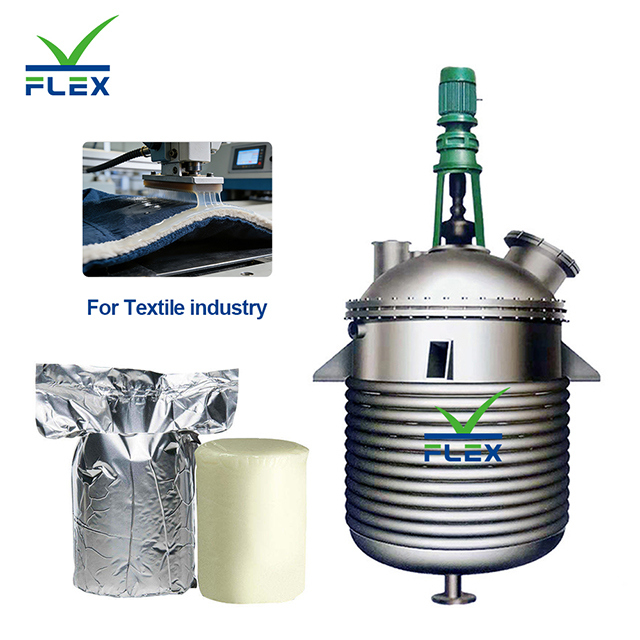
Reactive polyurethane (PUR) hot melt adhesive is one option for bonding textiles, foams, and other flexible materials.
PUR hot melt adhesive is applied in a heated state and develops its final properties through cooling and, for moisture-curing grades, a subsequent chemical curing reaction. This combination can support efficient processing while providing durable bonds after curing.
Compared with conventional adhesive systems, a suitable PUR formulation may offer several advantages for flexible composites.
Flexible bonding: An appropriately selected formulation can maintain the flexibility required for upholstery and other soft-touch materials.
Durable adhesion: Moisture-curing PUR grades can develop cross-linked structures that improve resistance to heat, aging, and other service conditions, depending on the formulation.
Controlled application: Hot melt processing allows adhesive to be applied through compatible coating systems, helping manufacturers manage adhesive distribution and consumption.
Solvent-free formulation options: PUR hot melt products are available without added solvents, although the environmental and workplace characteristics of a specific product should be confirmed using its technical and safety documentation.
For applications involving leather, fabric, and nonwoven materials, manufacturers can explore PUR hot melt adhesive for leather and fabric bonding.
The appropriate adhesive grade should be selected according to the substrate combination, required bond strength, processing conditions, and final product specifications. No adhesive should be assumed suitable for every foam or textile without testing.
Adhesive chemistry is only part of the solution. The equipment used to apply the adhesive and bring the substrates together also affects the final composite.
A suitable hot melt lamination machine can help manufacturers manage coating consistency, web tension, temperature, and lamination pressure throughout production.
Different coating methods serve different production requirements.
Roller coating can be suitable for a range of adhesive viscosities and substrate types. Slot-die coating can support controlled, uniform application when the adhesive and process are compatible with the system. Other coating methods may be appropriate depending on the required coating pattern, line speed, and material construction.
For foam-to-fabric bonding, the objective is to distribute enough adhesive to achieve the required adhesion without unnecessarily saturating the porous substrate.
The coating method should therefore be selected through material trials and confirmed against the required bond strength, flexibility, and appearance.
Adhesive temperature affects viscosity and application behavior. If the adhesive is too viscous for the selected coating system, distribution may become uneven. If the temperature is unsuitable for the formulation, adhesive performance or processing stability may be affected.
A well-configured lamination line should provide appropriate temperature management for the melter, delivery system, and coating equipment.
The operating temperature must follow the adhesive manufacturer's technical recommendations. Excessive heating or prolonged residence at elevated temperatures should be avoided where it could affect the material.
Fabric and foam can respond differently to tension during unwinding, feeding, and lamination. Uneven tension may contribute to wrinkles, misalignment, stretching, or dimensional changes after the material is released.
Web guides, suitable tension-control arrangements, and stable unwinding and rewinding help keep the substrates aligned throughout the process.
For automotive interior materials with stretch or dimensional sensitivity, tension settings should be established through production trials rather than copied from another material combination.
The nip rollers bring the coated substrates into contact. Their pressure and gap settings should be suitable for the material thickness and foam structure.
Too much pressure can compress the foam, while too little may result in incomplete contact or weak bonding. Manufacturers should test the pressure range against the desired thickness, surface appearance, and adhesion performance.
The objective is to establish a repeatable process window that supports both bond quality and the required soft feel.
Line speed affects coating stability, contact time, and the overall production process. The suitable speed depends on adhesive viscosity, coating weight, substrate properties, equipment capability, and the requirements of the final composite.
Increasing speed without validating these factors may lead to uneven coating or inconsistent bonding. Manufacturers should establish a stable combination of speed, temperature, coating conditions, and pressure before moving to higher output.
Choosing equipment for automotive foam-to-fabric bonding requires a clear understanding of the intended product and production requirements.
Selection factor | What manufacturers should evaluate |
|---|---|
Substrate compatibility | Foam type, fabric construction, thickness, stretch, and surface characteristics |
Adhesive compatibility | PUR formulation, viscosity, application temperature, and curing requirements |
Coating system | Suitable coating method, coating uniformity, and required adhesive application pattern |
Temperature control | Heating capability and stable temperature management for the selected adhesive |
Web handling | Unwinding, alignment, tension control, and rewinding requirements |
Lamination pressure | Adjustable pressure and gap settings appropriate for the substrate combination |
Production capacity | Required web width, target output, and a practical operating speed |
Quality verification | Peel adhesion, appearance, flexibility, dimensional stability, and relevant aging tests |
Maintenance | Cleaning procedures, adhesive handling, and access to components requiring routine service |
Manufacturers should provide the equipment supplier with representative samples of the foam, fabric, and adhesive wherever possible. This allows the proposed configuration to be assessed against actual materials rather than general assumptions.
FLEX Machinery's hot melt lamination machine range covers lamination applications involving fabrics, foams, films, and nonwovens. The required configuration should be confirmed according to the intended material combination and production process.
For related fabric-lamination applications, the PUR cloth-to-cloth lamination machine provides a reference for equipment designed to bond fabric layers. Where a process involves fabric and film rather than foam and fabric, the PUR cloth-to-film lamination machine is another relevant equipment option.
These machines illustrate different lamination configurations; the correct model for automotive foam-to-fabric bonding should be confirmed with FLEX Machinery based on the actual substrates and process requirements.
Before full-scale production, manufacturers should evaluate both adhesion and the physical characteristics of the finished composite.
A useful validation process includes the following checks.
Peel adhesion: Test whether the bond meets the required performance criteria and whether failure occurs at the adhesive interface or within the substrate.
Hand feel and flexibility: Compare the laminated material with the specified reference sample to determine whether the adhesive layer has made the composite undesirably stiff.
Appearance: Inspect for adhesive strike-through, visible marks, wrinkles, uneven bonding, or other surface defects.
Thickness and recovery: For foam-based products, check whether the lamination process has caused unacceptable compression or changes in the material's recovery behavior.
Environmental resistance: Where required, evaluate the composite after relevant temperature exposure, humidity conditioning, aging, or cleaning tests.
Process repeatability: Repeat trials under the intended operating conditions to confirm that the selected settings produce consistent results.
Acceptance criteria should be defined before testing. The required peel strength, flexibility, temperature resistance, and aging performance depend on the application and the customer's specifications.
For automotive components, qualification should follow the applicable customer requirements and testing procedures. Successful bonding in a small trial does not automatically establish long-term performance in a finished vehicle.
When a laminated composite fails to meet its requirements, reviewing the process systematically can help identify the cause.
Observed problem | Possible factors to investigate |
|---|---|
Fabric feels too stiff | Excessive coating weight, adhesive penetration, unsuitable adhesive grade, or excessive nip pressure |
Weak or uneven adhesion | Inconsistent coating, poor substrate contact, contamination, or unsuitable processing conditions |
Wrinkles or misalignment | Uneven web tension, inaccurate edge alignment, or unstable material feeding |
Foam thickness changes | Excessive nip pressure or unsuitable gap settings |
Adhesive application is inconsistent | Temperature fluctuations, viscosity changes, coating-system settings, or unstable material delivery |
Bond performance changes after aging | Adhesive-substrate compatibility, incomplete curing, or inadequate environmental validation |
These symptoms can have multiple causes. Manufacturers should change one relevant process variable at a time where practical, document the results, and verify the correction through repeat testing.
PUR hot melt adhesive is one option for flexible lamination applications. The suitable grade depends on the foam, fabric, required bond strength, processing conditions, and environmental performance requirements. Compatibility should be confirmed through technical review and trials.
Start by selecting a suitable adhesive and controlling its application quantity. Then optimize coating uniformity, substrate tension, nip pressure, and processing temperature. The final settings should be validated using the actual materials.
Equipment capability depends on the machine configuration and material properties. Web width, coating method, temperature control, tension management, and nip settings should be checked for each intended material combination.
No. Initial adhesion is only one part of the evaluation. Depending on the application, manufacturers may also need to verify curing, heat resistance, aging performance, flexibility, and other customer-specific requirements.
Prepare the substrate types, material thicknesses, web width, target production capacity, adhesive specifications, required coating method, and finished-product performance criteria. Sample materials and existing process data can help the supplier assess the required configuration.
Successful automotive interior lamination requires a balance between adhesion, flexibility, appearance, and production efficiency. The adhesive, coating method, web handling, and nip pressure must work together to achieve the required composite performance.
For manufacturers developing or upgrading a production line, the most reliable starting point is to define the material combination and finished-product requirements, then validate the process through trials.
Explore FLEX Machinery's hot melt lamination machines and PUR hot melt adhesive for leather and fabric bonding to discuss an equipment and adhesive configuration suited to your application.


