
English
Views: 0 Author: Site Editor Publish Time: 2026-10-18 Origin: Site


For BOPP tape manufacturers, consistent adhesive quality starts long before the coating stage. Variations in raw material dosing, mixing conditions, temperature control, or filtration can affect viscosity, coating performance, and the final tape's adhesion.
A well-designed BOPP acrylic adhesive production line helps manufacturers control these variables through coordinated mixing, dispersing, emulsifying, and filtering processes. The goal is not simply to produce one good batch, but to make production more repeatable as order volumes increase.
So, what should adhesive manufacturers focus on when selecting equipment for water-based acrylic adhesive production?
Batch variation rarely comes from a single factor. Raw material properties, formulation accuracy, operating conditions, and equipment configuration can all contribute to differences between production runs.
Common issues include:
Viscosity fluctuations: Differences in raw material ratios or mixing conditions can change the adhesive's flow behavior.
Uneven dispersion: Insufficient mixing or unsuitable shear conditions may leave some ingredients poorly distributed.
Temperature variations: Inadequate heating or cooling control can affect process stability, depending on the formulation.
Filtration problems: Agglomerates, contamination, or unsuitable filtration settings can interrupt downstream production.
Inconsistent operating procedures: Different feed sequences, mixing times, or operating parameters can make batch results harder to reproduce.
For manufacturers producing BOPP carton sealing tape, packaging labels, and other pressure-sensitive adhesive products, controlling these variables helps establish a more reliable production process.
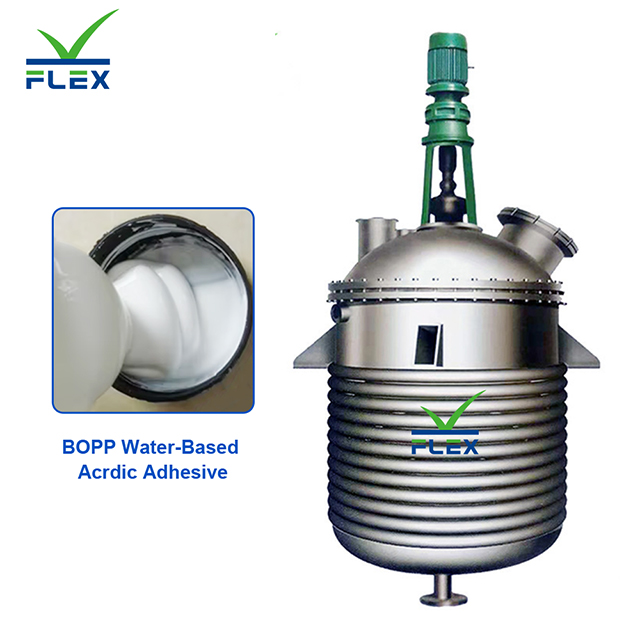
The reactor is one of the most important pieces of equipment in adhesive manufacturing. Its working volume, internal geometry, agitator design, and temperature-control system should match the actual formulation and production process.
A reactor that is too small may limit production capacity, while an unsuitable agitator may struggle to handle the material's viscosity or provide the required mixing action.
When evaluating a stainless steel adhesive reactor, manufacturers should consider:
Working volume and target batch size
Material viscosity throughout the process
Required mixing speed and shear conditions
Heating and cooling requirements
Compatibility between construction materials and the formulation
Cleaning, maintenance, and changeover requirements
The appropriate agitator depends on the process. Some stages require stronger dispersing action, while others may need gentler mixing to maintain uniformity without introducing unnecessary air.
FLEX Machinery offers stainless steel reactors for adhesive production, with configurations that can be adapted to different capacities, agitation requirements, and heating or cooling arrangements.
The key is to specify the reactor according to the formulation and process requirements rather than selecting equipment based on tank capacity alone.
Temperature management is another important consideration in water-based acrylic adhesive manufacturing.
Depending on the formulation, temperature changes can influence viscosity, dispersion behavior, reaction progress, and the stability of the finished adhesive. Inadequate heat transfer may also create differences between the material near the vessel wall and the material in other parts of the tank.
A suitable temperature-control system should be designed around the process rather than a universal temperature setting.
Before purchasing equipment, manufacturers should confirm:
The required operating temperature range
Whether the process needs heating, cooling, or both
How quickly the system must respond to temperature changes
The required temperature monitoring and control accuracy
Whether the cooling system can handle the process's maximum heat load
The actual operating parameters should be established through formulation trials and process validation. A temperature range suitable for one adhesive formulation may not be appropriate for another.
For larger production batches, cooling capacity deserves particular attention. Increasing batch volume can change the relationship between the amount of material being processed and the reactor's available heat-transfer area.
Batch consistency depends on how the entire production process works together, not just on the reactor itself.
Mixing distributes the ingredients, dispersing helps distribute components that require additional mechanical action, emulsification supports the required dispersion structure, and filtration removes unwanted particles or agglomerates before the material moves downstream.
Each stage should be configured according to the adhesive formulation.
For example, insufficient mixing may leave the batch nonuniform, while unsuitable dispersion conditions may affect the final material's properties. Filtration problems can also slow production or require additional cleaning and inspection.
FLEX Machinery's BOPP acrylic adhesive production line integrates mixing, dispersing, emulsifying, and filtering equipment into a coordinated production solution.
When evaluating a complete line, manufacturers should check whether the equipment capacity, transfer arrangements, filtration requirements, and operating sequence are compatible. A bottleneck in one stage can limit the performance of the entire system.
Even well-designed equipment cannot compensate for inconsistent operating procedures. Operators need clear process instructions and reliable records of the parameters used for each batch.
A practical control system should help the production team monitor and reproduce key settings, including:
Raw material quantities and feed sequence
Mixing speed and processing time
Temperature settings and operating history
Emulsification conditions, where applicable
Filtration and transfer conditions
Batch identification and quality inspection results
PLC-based controls can help operators manage process settings and reduce unnecessary manual adjustments. Where supported by the equipment configuration, stored recipes can also make it easier to reproduce established production procedures.
However, automation alone does not guarantee consistent adhesive quality. Formulation control, raw material quality, equipment suitability, operator training, and product testing remain important.
Manufacturers should establish acceptance criteria for the finished adhesive based on its intended application. Depending on the product, these may include viscosity, solids content, tack, peel adhesion, cohesion, or other relevant performance tests.
Moving directly from laboratory development to full-scale production can introduce avoidable risks. Mixing behavior, heat transfer, and processing time may change as batch volume increases.
Pilot testing helps manufacturers identify these differences before committing larger quantities of raw materials.
A 50–100 L laboratory reactor mixer can be considered when developing or evaluating formulations before production-scale implementation.
During pilot trials, manufacturers should record the formulation, batch volume, operating conditions, processing time, and test results. These records provide a basis for evaluating whether the process can be transferred to a larger reactor.
Scale-up should then be reviewed against the proposed production equipment's mixing capability, heat-transfer performance, filtration requirements, and expected output.
The purpose is to identify the process conditions that need to be maintained and the equipment features needed to reproduce them at a larger scale.
Before requesting a quotation, prepare the following information for the equipment supplier:
Item | What to confirm |
|---|---|
Adhesive type | Water-based acrylic adhesive and its intended application |
Production capacity | Target batch volume and daily output |
Formulation requirements | Raw material properties, viscosity range, and processing conditions |
Reactor configuration | Working volume, agitator type, and mixing requirements |
Temperature control | Heating method, cooling capacity, and monitoring requirements |
Filtration | Required filtration stages and target filtration performance |
Automation | PLC control, process monitoring, and recipe management requirements |
Plant utilities | Available power, water, cooling, and other required utilities |
Quality control | Tests and acceptance criteria for the finished adhesive |
Future expansion | Expected changes in production volume or product range |
The more clearly these requirements are defined, the easier it becomes to evaluate whether a proposed production line fits the actual process.
FLEX Machinery provides BOPP acrylic adhesive production equipment with configurable capacity options and support for water-based acrylic adhesive manufacturing. The company's equipment range also includes stainless steel reactors for different adhesive and resin processes.
Potential causes include raw material differences, inaccurate dosing, inconsistent mixing conditions, temperature variation, and changes in the formulation or processing procedure. The actual cause should be identified through process records and product testing rather than corrected by changing mixing speed alone.
Reactor volume, agitation, heat transfer, and material compatibility influence how well the equipment can support the required process. The configuration should match the formulation, viscosity, production scale, and operating conditions.
Potentially, but compatibility depends on the formulations, equipment configuration, cleaning requirements, and required process conditions. Manufacturers should confirm the intended product range with the equipment supplier before selecting a line.
Start with controlled raw material dosing, suitable mixing and temperature-control equipment, repeatable operating procedures, appropriate filtration, and consistent quality testing. Recording and reviewing process data helps identify variation and improve repeatability over time.
Consistent water-based acrylic adhesive production requires more than a suitable formula. Reactor configuration, mixing conditions, temperature management, filtration, and process control must work together to support repeatable results.
For manufacturers planning a new facility or upgrading an existing line, the first step is to define the formulation, target capacity, and required product performance. These details help determine the equipment configuration and identify potential process bottlenecks before production begins.
Explore FLEX Machinery's BOPP acrylic adhesive production line or stainless steel reactor solutions to discuss equipment requirements for your water-based acrylic adhesive manufacturing process.


