
English
Views: 0 Author: Site Editor Publish Time: 2026-10-21 Origin: Site


When purchasing a stainless steel reactor for adhesive production, tank capacity is only one part of the decision. The material grade, mixing system, heating and cooling method, sealing arrangement, and level of automation all affect how well the equipment fits the manufacturing process.
Different adhesives also have different production requirements. Water-based acrylic adhesives may require controlled mixing, dispersion, emulsification, and temperature management. High-viscosity hot melt adhesives place different demands on heating and agitation, while some resin and polyurethane prepolymer processes require carefully controlled reaction conditions.
Choosing the right stainless steel reactor for adhesive production starts with understanding the material being processed and the operating conditions the equipment must support.
The reactor's material of construction should be compatible with the raw materials, solvents, additives, cleaning agents, and process conditions used in production.
FLEX Machinery offers stainless steel reactors in SS304 and SS316L configurations. The appropriate grade depends on the chemical compatibility requirements of the specific process.
SS304 stainless steel is widely used for industrial mixing and processing equipment. It may be suitable for conventional adhesive and resin formulations when the ingredients, temperature, and operating environment are compatible with the material.
Before selecting SS304, manufacturers should review the chemical composition of the adhesive, the presence of corrosive ingredients, and the conditions expected during production and cleaning.
SS316L may be worth considering when the process involves more demanding corrosion conditions. Its alloy composition provides improved resistance to certain forms of corrosion compared with SS304, although the actual performance depends on the chemicals, concentrations, temperatures, and exposure conditions involved.
It should not automatically be treated as the required material for every adhesive reactor. Instead, the material grade should be selected after reviewing the formulation and operating environment.
When requesting a quotation, provide the supplier with the main raw materials, relevant chemical concentrations, process temperatures, and cleaning requirements.
FLEX Machinery's stainless steel reactor range supports SS304 and SS316L configurations, with material selection and other equipment options tailored to the intended application.
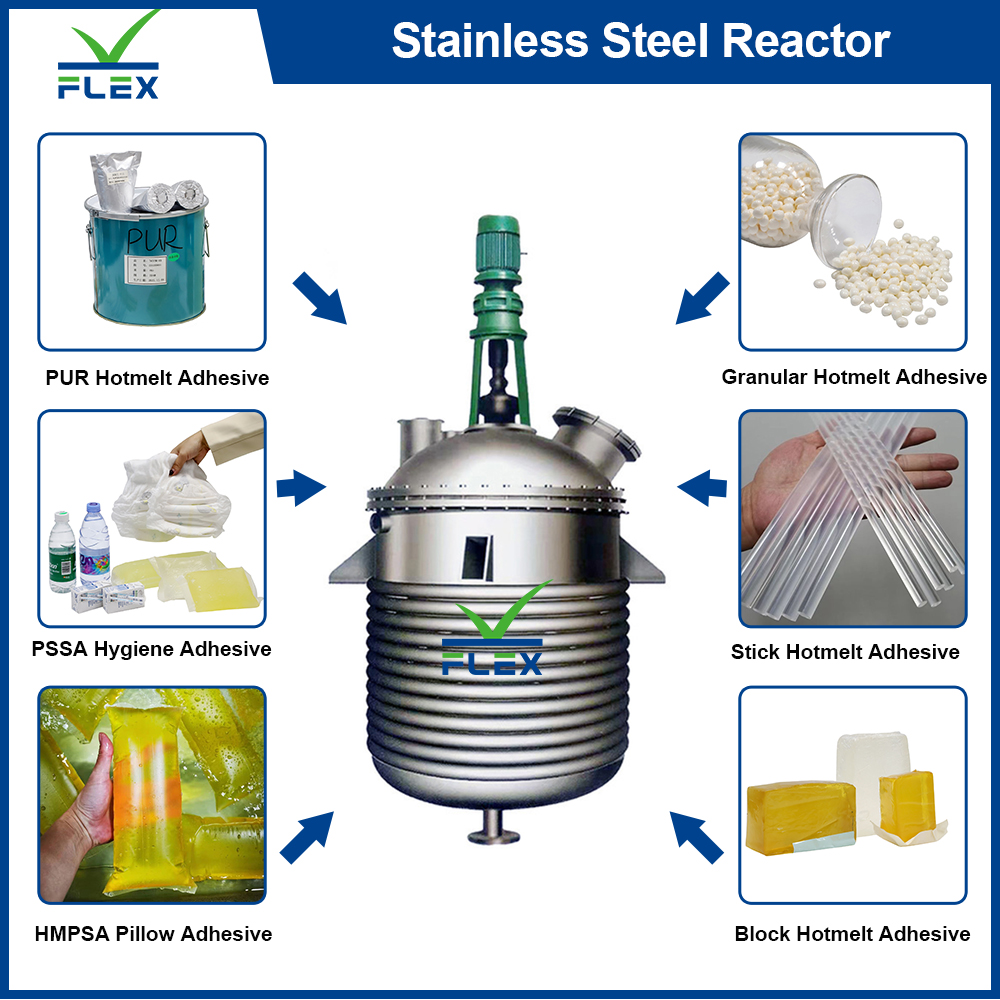
A reactor that is too small can restrict production, while an oversized vessel may increase equipment costs and make smaller batches less practical.
The right capacity should be based on the actual batch size, production schedule, material properties, and required output—not simply the annual sales target.
Before selecting a reactor, consider:
Target batch size: Determine the amount of finished material required per batch.
Working volume: Allow suitable space for mixing, material expansion where applicable, and any foaming or process requirements.
Batch cycle time: Include charging, processing, cooling, discharge, and cleaning.
Production schedule: Consider the number of batches required per shift and the time available for changeovers.
Future demand: Decide whether the equipment should support expected production growth or additional formulations.
Working volume and total vessel capacity are not necessarily the same. The required operating level depends on the process and should be confirmed with the equipment supplier.
For manufacturers developing new formulations or conducting small-batch trials, a 50–100 L laboratory reactor mixer may be a suitable starting point. Its compact configuration is intended for research, testing, and small-batch production.
For larger operations, FLEX Machinery offers industrial stainless steel reactors in different configurations. Confirm the available working volumes and production capacity for the specific model before finalizing the equipment specification.
The mixing system is one of the most important components of an adhesive reactor. An unsuitable agitator can make it difficult to achieve uniform mixing, distribute additives, or maintain consistent processing conditions.
However, there is no single agitator that works best for every adhesive. Selection depends on viscosity, material behavior, batch geometry, the required mixing action, and whether the process needs dispersion or simply blending.
Anchor agitators move material through the vessel and can be useful for many viscous products. Where wall scraping is required, compatible scraper elements can help remove material from the inner surface and support heat transfer.
This configuration may be worth evaluating for certain high-viscosity adhesives, resins, and sealant materials, particularly when wall buildup is a concern.
Helical ribbon agitators can be considered for materials that require substantial movement throughout the vessel. Their suitability depends on the product's flow behavior, batch size, and mixing objective.
The supplier should confirm whether the design can handle the actual viscosity range and provide the required circulation.
Turbine agitators and high-shear dispersers serve different mixing purposes. Depending on the formulation, they may help incorporate ingredients, disperse additives, or achieve the required material uniformity.
High shear is not always necessary. Some formulations require controlled, gentler mixing, so the agitation system should match the process rather than use the most powerful option by default.
FLEX Machinery lists scraper anchor, helical ribbon, turbine, and high-shear disperser options within its stainless steel reactor product range.
When discussing the agitator with the supplier, provide the expected viscosity range, material behavior during processing, required mixing result, and any limitations on shear or air incorporation.
Temperature control affects viscosity, mixing behavior, material stability, and processing time. The appropriate system depends on whether the process requires heating, cooling, or both.
Electric heating may be suitable for processes where electrical heating is compatible with the required temperature range, heating rate, and available utilities.
The supplier should confirm the heating capacity, control method, and suitability for the intended batch size.
Steam may be appropriate where the plant already has a suitable steam supply and the process requires indirect heating through a jacket or coil.
The system should be designed around the available steam conditions, heat-transfer requirements, and applicable pressure limits.
Thermal oil may be considered for processes that require higher operating temperatures or specific heat-transfer characteristics. Its suitability depends on the process requirements and the plant's heating system.
Cooling may be just as important as heating, especially when the process generates heat or requires the material to reach a specific temperature before discharge.
When specifying the temperature-control system, confirm:
The required operating temperature range
Heating and cooling duties
The desired heating or cooling rate
Temperature measurement and control requirements
Available plant utilities
Whether the process requires monitoring at multiple locations
A jacketed or coil-heated reactor can be configured according to the process and heat-transfer requirements. The appropriate design should be selected with the supplier rather than assuming one jacket type suits every application.
For BOPP tape adhesive manufacturers, FLEX Machinery's BOPP acrylic adhesive production line provides a more application-specific solution integrating mixing, dispersing, emulsifying, and filtering processes for water-based acrylic adhesive manufacturing.
Vacuum and pressure systems can be important for certain adhesive manufacturing processes, but they are not universal requirements.
The decision should depend on the formulation, process stages, material behavior, and the operating conditions specified for the equipment.
Vacuum may be required for processes that need degassing or the removal of certain volatile components under controlled conditions. It can also be relevant when entrained air affects the appearance or performance of the finished product.
Before specifying a vacuum system, confirm the required vacuum level, operating temperature, vapor characteristics, and whether a condenser or other supporting equipment is necessary.
The vessel, seals, piping, and connected components must be designed for the intended vacuum conditions.
Some chemical reactions or processing operations require a pressurized environment. Others operate under atmospheric conditions or vacuum.
The equipment's design pressure, operating pressure, safety devices, and applicable standards must be defined according to the process. Pressure-rated equipment should not be selected based solely on the assumption that higher pressure provides better mixing or production performance.
FLEX Machinery lists pressure and vacuum options for its reactor systems, including configurations that can incorporate mechanical seals, pressure-relief devices, nitrogen blanketing, and condensers where required.
Manufacturers should confirm which of these features are necessary for their particular formulation and plant conditions.
A reactor's performance depends not only on its main vessel and agitator, but also on the seals, connections, internal finish, and cleaning arrangements.
Adhesive residues can accumulate on internal surfaces or around connections. If a plant frequently changes formulations, cleaning requirements become especially important.
Before purchasing the equipment, evaluate the following.
Mechanical seals and gaskets: Confirm compatibility with the processed materials, solvents, temperature, and pressure or vacuum conditions.
Internal surface finish: Specify the required finish according to the product, cleaning procedure, and contamination-control needs. FLEX's reactor range lists an internal surface roughness of Ra 0.4–0.6 μm, with electropolishing available as an option. Any tighter requirement should be agreed upon with the supplier.
Access for cleaning: Check the manway, ports, internal components, and access arrangements needed for inspection and maintenance.
Cleaning between batches: Confirm whether manual cleaning is sufficient or whether a clean-in-place arrangement is appropriate for the process.
Maintenance access: Review access to seals, bearings, motors, gearboxes, valves, and other components requiring inspection or replacement.
Changeover requirements: If the same reactor will process multiple formulations, consider the potential for residue, cross-contamination, cleaning time, and material compatibility.
The right configuration can help make routine cleaning more manageable and reduce unnecessary downtime. However, cleaning performance should be evaluated against the actual adhesive formulation and the plant's procedures.
Automation can help operators manage process settings and make established procedures easier to reproduce. The appropriate level depends on production volume, the number of formulations, labor requirements, and the need for process records.
A basic configuration may rely on manual adjustments for some operations. A more automated system can incorporate PLC/HMI controls, recipe management, alarms, and process monitoring.
When specifying automation, consider:
Temperature and mixing-speed control
Motor and drive configuration
Monitoring of relevant pressure or vacuum conditions
Raw material dosing and weighing requirements
Alarm and safety functions
Batch records and traceability
Integration with pumps, filtration, storage, or filling equipment
Not every plant needs a fully automated system. For operations with frequent formulation changes, larger batch volumes, or more demanding process-control requirements, additional automation may provide practical benefits.
FLEX Machinery offers automation options that can be configured around the process, including PLC/HMI controls and optional dosing and monitoring components. The supplier should confirm which functions are included in the proposed model and which require additional equipment.
A formulation that works in a laboratory vessel may behave differently when transferred to production scale. Larger batches change the relationship between vessel geometry, mixing, heat transfer, and processing time.
This is why scale-up should be considered before purchasing a production reactor.
During development and pilot trials, record the formulation, batch size, mixing conditions, temperature profile, processing time, and quality results. Use this information to discuss the production configuration with the equipment supplier.
For manufacturers working on water-based acrylic adhesives, the BOPP acrylic adhesive production line offers a relevant example of an integrated system for mixing, dispersing, emulsifying, and filtering.
For broader adhesive and resin applications, the stainless steel reactor range can be configured according to the intended process.
When moving from pilot production to a larger vessel, confirm that the mixing system, heat-transfer capacity, discharge arrangements, and process controls remain suitable for the required output.
Before requesting a quotation, prepare the following information for your equipment supplier.
Specification | Information to prepare |
|---|---|
Product type | Water-based adhesive, hot melt adhesive, resin, PUR prepolymer, or other formulation |
Raw materials | Main ingredients, solvents, additives, and relevant compatibility requirements |
Material grade | SS304, SS316L, or another grade based on the process |
Batch size | Target working volume and required production output |
Viscosity | Expected viscosity range and changes during processing |
Agitation | Required mixing, blending, dispersion, or wall-scraping functions |
Temperature | Operating range, heating duty, cooling duty, and control requirements |
Pressure and vacuum | Whether either is required, together with the design conditions |
Sealing | Requirements based on the material and operating environment |
Cleaning | Manual cleaning, changeover frequency, and any CIP requirements |
Automation | Required controls, alarms, dosing, and process records |
Plant utilities | Available electrical supply, steam, thermal oil, cooling water, and other services |
Future expansion | Expected changes in batch size, formulations, or production volume |
Providing these details helps the supplier recommend a configuration based on actual production requirements rather than general equipment specifications.
Not necessarily. SS316L offers improved resistance to certain corrosive environments, but the appropriate material depends on the adhesive formulation, process conditions, and cleaning chemicals. SS304 may be suitable for many conventional applications. Confirm material compatibility before selecting the reactor.
No. Vacuum is useful for processes that require degassing or other vacuum-related operations, but it is not essential for every adhesive formulation. The requirement should be established from the process specification.
The appropriate agitator depends on the viscosity range, vessel geometry, required circulation, and whether the process needs blending, dispersion, or wall scraping. Anchor, helical ribbon, and other configurations should be evaluated against the actual material properties.
Start with the required batch size and production schedule. Consider working volume, cycle time, cleaning, and future demand. Confirm the vessel's usable working volume and available configuration with the supplier.
Potentially, but compatibility depends on the formulations, operating conditions, cleaning procedures, and equipment configuration. Manufacturers should confirm whether the same vessel can safely and effectively process the intended product range.
A stainless steel reactor is a key part of adhesive manufacturing, but its suitability depends on how well the equipment matches the process.
Material compatibility, batch capacity, agitation, heat transfer, pressure or vacuum requirements, cleaning, and automation should be evaluated together. Specifying these requirements early helps manufacturers avoid paying for unnecessary features or overlooking components that are important to production.
FLEX Machinery supplies stainless steel reactors for adhesive and resin production, along with application-specific solutions such as the BOPP acrylic adhesive production line.
Before requesting a quotation, prepare your formulation details, viscosity range, target batch size, operating temperatures, and any pressure or vacuum requirements. This gives the equipment supplier a clearer basis for recommending a reactor configuration suited to your manufacturing process.


