
English
Views: 0 Author: Site Editor Publish Time: 2026-09-04 Origin: Site


Polyurethane Reactive (PUR) hot melt adhesive cures rapidly through ambient moisture exposure. A single packaging failure does not just cause a minor leak on the production floor. It completely ruins the entire batch by triggering an irreversible chemical reaction. For manufacturers, choosing the correct packaging geometry and barrier material is non-negotiable. Round bottom foil liners specifically engineered for standard adhesive drums prevent premature cross-linking. They also eliminate costly extraction waste during processing. This guide outlines the critical technical specifications, sizing standards, and evaluation criteria for selecting reliable PUR foil liners. You will learn how to identify high-quality materials and evaluate essential mechanical properties. We will also explore how the right liner protects product integrity directly from the manufacturing plant floor to the end user.
 |  |
Moisture Isolation: Multi-layered aluminum foil construction provides a near-zero Moisture Vapor Transmission Rate (MVTR), halting premature PUR curing.
Geometry Matters: The heat-sealed round bottom design perfectly contours to standard cylindrical drums, preventing adhesive trapping in corners and reducing material waste.
Scalable Sizing: Standard capacities (2L, 20L, 200L) align precisely with commercial drum melters and platen unloaders.
Risk Mitigation: Evaluating puncture resistance and heat-seal integrity is critical to avoiding catastrophic leaks during transit or high-pressure dispensing.
Understanding the moisture-cure problem requires examining the chemical reality of polyurethane adhesives. PUR relies heavily on isocyanate groups. These chemical groups react aggressively when exposed to ambient humidity. Traditional Ethylene Vinyl Acetate (EVA) hot melts act differently. They melt when heated and solidify when cooled. You can remelt EVA multiple times without damaging the product. PUR undergoes an irreversible cross-linking process instead. Once humidity triggers the curing cycle, the adhesive hardens permanently. You cannot melt it again. This distinct chemical reality makes highly specialized PUR hot melt adhesive packaging strictly essential.
Standard packaging solutions fail rapidly under these demanding conditions. Standard plastic bags use materials like Low-Density Polyethylene (LDPE). These plastics have high moisture permeability. Ambient humidity passes directly through the plastic wall over time. Flat-bottom bags introduce severe geometric failures. A flat design creates overlapping folds when stuffed inside a cylindrical drum. These tight folds rub against the rigid drum walls during shipping. The constant friction creates microscopic pinholes. Air pockets also form in the bottom corners, trapping ambient humidity directly against the adhesive.
The business impact of packaging failure goes far beyond replacing a single wasted bag. We see production facilities face severe operational consequences:
Wasted Adhesive: A thick, cured skin forms on top of the adhesive block. In severe cases, the entire container hardens. Operators must scrap the whole batch.
Clogged Platen Unloaders: Micro-cured flakes break off into the melting system. They travel into the heated hoses and clog dispensing nozzles entirely.
Halted Production Lines: Assembly stops completely. Technicians must dismantle the melter to clear hard blockages.
Clean-up Labor: Operators spend hours manually scraping hardened polyurethane from delicate metal machine components.
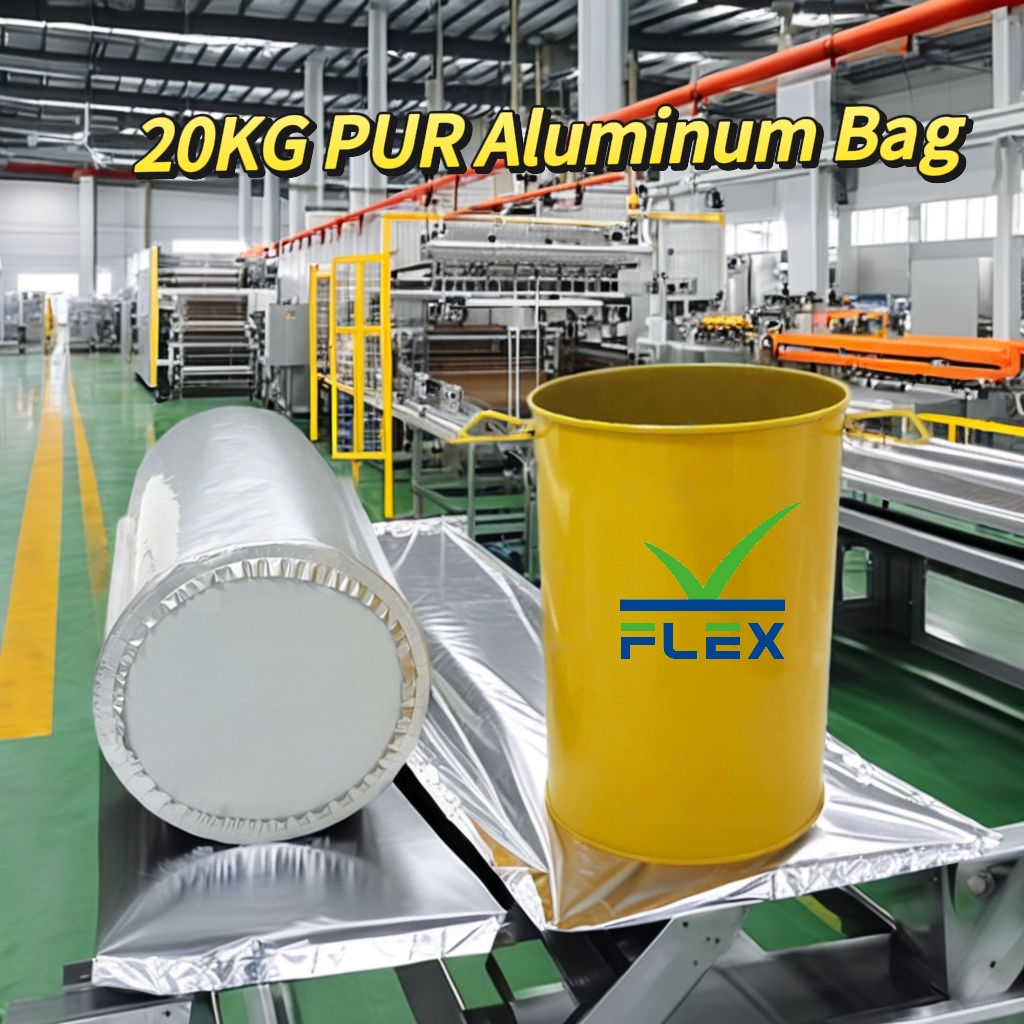 |  |
Multi-ply barrier construction forms the absolute foundation of adhesive protection. Manufacturers use a complex lamination process to combine four distinct material layers. Every single layer serves a highly specific mechanical purpose. When evaluating an Aluminum foil bag for PUR adhesive, look for this standardized four-ply structure. The Polyethylene Terephthalate (PET) forms the outer protective layer. It provides initial scuff resistance. The Aluminum (AL) acts as the absolute barrier layer. It blocks moisture vapor and oxygen transmission entirely. The Nylon (NY) delivers extreme puncture resistance. It absorbs impact energy during transport and prevents the aluminum from cracking. Finally, the Polyethylene (PE) serves as the inner sealing layer. It melts uniformly to create an airtight heat seal along the seams.
Round-bottom geometry offers massive advantages over traditional flat designs. Flat bags bunch up aggressively inside round containers. This bunching traps expensive adhesive inside the hidden folds. A round-bottom design mirrors the internal shape of a cylindrical drum perfectly. The platen unloader features a heated circular plate. This heavy plate pushes down into the drum to melt and extract the glue. The contoured bag fit ensures the platen plate scrapes the sides cleanly. It consistently extracts up to 99% of the material. The smooth fit also prevents the descending platen from catching the bag and tearing it open.
Heat-seal integrity determines the ultimate success of the container. The circular bottom seam requires absolute precision engineering. High-capacity drum melters apply massive downward hydraulic pressure. The bag must hold the liquid adhesive securely inside the drum. A weak seam ruptures instantly under this extreme mechanical stress. Manufacturers use specialized hot-jaw sealing machines to fuse the PE layers together. This precision process creates a welded bond stronger than the surrounding foil itself.
Aligning your bag capacity carefully with your commercial dispensing equipment is crucial. You must select the precise size for your specific operational scale.
The 2L to 5L sizes serve small batch operations perfectly. You use them for custom edge banding, low-volume profile wrapping, or testing pilot adhesive formulations. They drop perfectly into standard tabletop melters. You minimize material waste when running short production shifts.
The 20L or 5-gallon sizes handle mid-volume production demands. This represents the gold standard size for mid-sized manufacturing. The woodworking, automotive interior assembly, and bookbinding industries rely heavily on this exact size. The bag sits flawlessly inside a standard steel 5-gallon pail. It matches commercial 5-gallon pail unloaders perfectly.
The 200L or 55-gallon sizes support continuous high-volume industrial manufacturing. Bulk manufacturing requires massive adhesive throughput. These large liners support continuous flat lamination lines and major automotive assembly plants. They demand the heaviest 4-ply foil available. A 55-gallon platen unloader generates immense hydrostatic pressure and downward friction. The PUR Aluminum Foil Round Bottom Bag endures this severe mechanical force for hours without yielding.
 |  |
Table: PUR Glue Packaging Bag Capacity and Application Chart
Capacity | Target Equipment | Primary Applications |
|---|---|---|
2L - 5L | Tabletop Melters | Prototyping, Custom Edge Banding, Testing |
20L (5-Gallon) | 5-Gallon Pail Unloaders | Woodworking, Bookbinding, Automotive Interiors |
200L (55-Gallon) | 55-Gallon Drum Melters | Bulk Flat Lamination, High-Volume Assembly |
You must demand verifiable testing data from your suppliers. Request the Moisture Vapor Transmission Rate (MVTR) and Oxygen Transmission Rate (OTR). Look for laboratory testing conducted under standard ASTM protocols. The ideal MVTR for PUR packaging approaches absolute zero. Any measurable permeability compromises the adhesive quality over time.
Buyers often assume thicker foil provides better protection. This represents a dangerous common mistake. You must evaluate the delicate balance between barrier thickness and mechanical flexibility. Barrier thickness typically ranges between 120 and 160 microns. If the foil becomes too thick, it turns rigid. Rigid foil develops microscopic stress cracks when it bends to fit the drum. These micro-cracks destroy the moisture barrier instantly.
Transport environments remain brutal on industrial packaging. Drums face forklift impacts, truck vibrations, and sudden pallet drops. Assess the mechanical tensile strength of the bag material carefully. Ensure the PUR glue packaging bag passes rigorous drop tests. The circular bottom seam must remain completely intact after a standard one-meter drop test.
The bag diameter must sit entirely flush against the internal walls of the rigid drum. Do not accept wide manufacturing dimensional tolerances. Oversized bags fold over themselves, creating immediate weak points. Undersized bags stretch taut like a drumhead. When operators pour the heavy adhesive in, the stretched bag tears directly at the seams.
Air pockets present a massive operational hurdle during the filling process. Ambient air contains naturally high humidity. If air gets trapped between the hot adhesive and the final top seal, the adhesive reacts immediately. A thick, cured skin forms on the surface. Operators must purge all ambient air before sealing the top entirely. Many facilities use vacuum sealers or nitrogen gas flushes to displace the air completely.
Poor fitment leads directly to severe equipment contamination. As the heated platen unloader descends, it scrapes the internal sides of the drum. If the bag fits loosely, the platen catches the excess foil folds. It drags the foil downwards, pulling it directly into the intake pump. Shredded foil contaminates the entire adhesive supply line. You must dismantle the melter completely to remove the metal shreds safely.
We must transparently address warehouse storage realities. High-barrier bags offer extreme internal protection. However, they do not replace the need for careful external handling. You must maintain temperature-controlled storage facilities. Extreme heat degrades the adhesive prematurely, regardless of the moisture barrier quality. Forklift operators must handle the drums with strict care. A single careless forklift tine puncture ruins the internal bag instantly.
Never commit to a bulk packaging order without conducting physical trials first. Request sample bags from your supplier. Insert the sample into your specific production drum. Fill it with your exact chemical adhesive. Run it through your daily platen unloader cycle. This real-world test validates dimensional accuracy and seal strength under genuine stress.
Manufacturing environments matter deeply when selecting a partner. Look for suppliers holding recognized ISO certifications. You need an absolute guarantee of dust-free and moisture-free bag production. A certified cleanroom manufacturing facility prevents microscopic contaminants from entering the bag before shipping.
Review your operational requirements carefully. Decide if you need custom bag heights to fit proprietary drum designs. Standard 20L and 200L specifications usually meet the vast majority of operational needs. Choosing standard sizes simplifies your supply chain and reduces lead times significantly. Focus your efforts on sourcing a highly reliable PUR adhesive packaging solution from a vetted, experienced manufacturer.
The PUR aluminum foil round bottom bag operates as an active component in preserving adhesive efficacy. It is not merely a passive storage container. It blocks moisture aggressively, ensures smooth machine extraction, and protects your entire production line from catastrophic downtime. Prioritize dimensional accuracy and seal strength above raw cost per unit. The financial loss of a single cured 200L drum is massive. It far outweighs the tiny savings gained by buying an inferior, highly permeable liner. Protect your product thoroughly by investing in engineered barrier packaging.
A: High-barrier foil liners typically extend PUR adhesive shelf life to 6 or 12 months. This assumes the heat seals remain completely intact. You must also maintain proper ambient storage temperatures. Any puncture instantly compromises this extended shelf life by letting ambient moisture enter.
A: You can use them, but it is highly cost-prohibitive. Standard EVA and PSA adhesives do not react to ambient moisture. Multi-layer foil is completely over-engineered for these basic adhesives. A standard silicone-coated paper or basic plastic liner works perfectly fine for non-reactive glues.
A: You must purge all remaining air from the bag first. Operators typically use an inert gas like nitrogen for this purging process. After purging the air, you must re-heat-seal the foil immediately. Alternatively, you can use specialized heavy-duty mechanical clamps to block moisture entry completely.
A: Recycling multi-layer laminated materials remains extremely difficult. The combination of plastic and aluminum layers resists standard recycling separation processes. Furthermore, once contaminated with reactive polyurethane adhesive, the bag becomes industrial waste. You must dispose of it strictly according to local chemical waste regulations.


