
English
Views: 0 Author: Site Editor Publish Time: 2026-10-24 Origin: Site


Formulating a high-grade silicone sealant is only half the battle. How you package, store, and dispense that thixotropic material ultimately dictates its market survival. Silicone sealants remain thick and viscous under normal resting conditions but flow smoothly when subjected to pressure. This highly specific rheology demands meticulously engineered packaging to ensure long-term stability and effortless usability on the job site.
Recent market data analyzing commercial construction procurement highlights a massive industry pivot. While rigid high-density polyethylene tubes invariably retain their stronghold in the residential DIY sector, massive commercial glazing projects are aggressively specifying flexible foil sausages. This shift is not merely a preference. It is heavily driven by strict job-site waste reduction mandates and the soaring disposal costs associated with raw plastics. Consequently, chemical compounders must adapt their factory floors to handle flexible packaging efficiently or risk losing lucrative commercial contracts to more agile competitors.
Different buyer personas dictate these distinct packaging requirements. Weekend DIY enthusiasts prioritize convenience and compatibility with inexpensive hand tools. Professional contractors focus on material volume, rapid application speeds, and minimizing dumpster fees. Meanwhile, industrial facilities demand bulk formats compatible with robotic dispensing systems. Transitioning between a rigid plastic tube, a flexible foil film, and a massive steel drum requires highly specialized filling equipment engineered to handle extreme viscosities while maintaining precise volumetric dosing and preventing air entrapment.
The standard rigid cartridge remains the most globally recognized sealant packaging format. Typically manufactured from high-density polyethylene or multi-layered cardboard, the dominant size on retail hardware shelves is the 10 oz or approximately 300ml cartridge.
This format rules retail distribution channels for several highly practical reasons. Its primary advantage is structural rigidity. A hard plastic shell safeguards the sensitive sealant from physical impact during transit and retail display. The rigid tube is universally compatible with standard mechanical caulk guns, making it the default choice for homeowners who want a reliable seal without investing in specialized dispensing gear. The thick plastic walls act as a formidable barrier against moisture vapor transmission to safeguard the product's shelf life.
Processing high-viscosity silicone into a rigid tube requires precise mechanical engineering. A dedicated cartridge filling machine operates through a systematic sequence. It handles empty tube feeding, volumetric filling, plunger insertion, and final air evacuation without missing a beat.
Stepping onto the factory floor, the most critical phase occurs right at the extrusion nozzle. Because silicone viscosity often ranges from 100,000 to 500,000 centipoise, it behaves more like a dense paste than a liquid. To combat this resistance, the machinery utilizes a bottom-up filling technique. The nozzle descends completely to the base of the empty cartridge and slowly retracts upward as the sealant is pumped in. This synchronized movement prevents the formation of hidden air pockets. Trapped air is a manufacturer's worst enemy. It causes the sealant to sputter or pop during application, leaving vulnerable gaps in the final bead and leading to costly contractor callbacks. After the precise volume is injected, a mechanical press forcefully seats a rigid plastic plunger into the base to hermetically seal the material inside.
Facility managers must select their capital equipment based on target throughput and available workforce. For boutique compounders or facilities managing frequent custom color batches, a semi-automatic cartridge filling machine provides a highly cost-effective entry point. Operating this setup requires a human operator to manually place empty cartridges and plungers into the machine's holding blocks. The equipment then executes the precise filling and insertion steps. While highly reliable, this method limits production speed to the operator's physical dexterity, typically yielding 15 to 25 finished units per minute.
Supplying national retail chains requires vastly superior output. High-volume manufacturers rely on a fully automatic sealant cartridge filling line to eliminate manual intervention entirely. Empty cartridges are dumped into a bulk hopper, automatically sorted by vibratory bowls, and fed into the filling station via a high-speed conveyor. Following the automated fill and cap sequence, the cartridges seamlessly pass under inline inkjet printers for batch coding. By operating at robust speeds of 30 to 50 cartridges per minute, these systems drastically reduce per-unit labor costs and eliminate operator fatigue.
The 20 oz or roughly 600ml sausage foil pack is aggressively capturing market share within the commercial construction and professional glazing sectors. Rather than relying on a hard plastic shell, this format utilizes a thin, flexible, multi-layered aluminum foil film.
Professional contractors advocate for sausage packs based on empirical field data. They hold double the volume of a standard retail cartridge, which significantly cuts down the frequency of tool reloading during expansive curtain-wall installations. The environmental disposal metrics are vastly superior. When a rigid cartridge is fully dispensed, the plastic tube retains its exact original shape and consumes massive amounts of space in job-site dumpsters. A fully dispensed sausage pack compresses into a flat, tiny disk, generating up to 95 percent less waste volume. The aluminum foil composition provides an exceptional hermetic seal that blocks ambient humidity and drastically extends the sealant's workable shelf life.
Handling delicate, flexible foil requires an entirely different mechanical approach compared to rigid plastic processing. A high-performance sausage sealant filling machine is a complex, precision-driven piece of equipment. It must simultaneously manage continuous film tension, precise volumetric extrusion, and secure mechanical clipping without tearing the packaging.
Instead of pressing a plastic cap into a tube, this machinery pumps the dense silicone directly into a dynamically formed tube wrapped around a mandrel. Because the thin foil is highly susceptible to bursting under sudden pressure spikes, the extrusion rate must be flawlessly controlled. Advanced systems deploy dual-cylinder hydraulic or servo-driven pumping mechanisms to ensure a continuous, non-pulsing flow of material. Factory operators often note that when these advanced dual-cylinder systems are perfectly calibrated, the foil film glides through the tensioners without a single crease, easily achieving production speeds of 20 to 30 pieces per minute. Once the target volume is reached, the machine automatically gathers the foil ends and crimps them tightly using specialized aluminum wire clips to create a leak-proof seal.
Looking beyond hardware store shelves and commercial high-rises, silicone sealants are heavily utilized in industrial manufacturing environments. Sectors such as aerospace engineering, automotive assembly, and heavy equipment fabrication consume sealants in massive quantities for structural bonding and automated form-in-place gasketing.
Standard cartridges or sausages are entirely inefficient for these high-consumption applications. The industrial market relies heavily on 5-gallon or 20-liter pails and 55-gallon or 200-liter bulk drums. Factory end-users typically deploy heavy-duty pneumatic or hydraulic extrusion pumps that press directly down into these massive drums. This feeds the raw sealant through high-pressure hoses directly to robotic dispensing arms or manual assembly stations.
Packaging sealant into bulk containers requires a complete departure from standard volumetric dosing. The machinery engineered for pails and drums prioritizes continuous, high-pressure flow capacity and precise gravimetric weight-based accuracy.
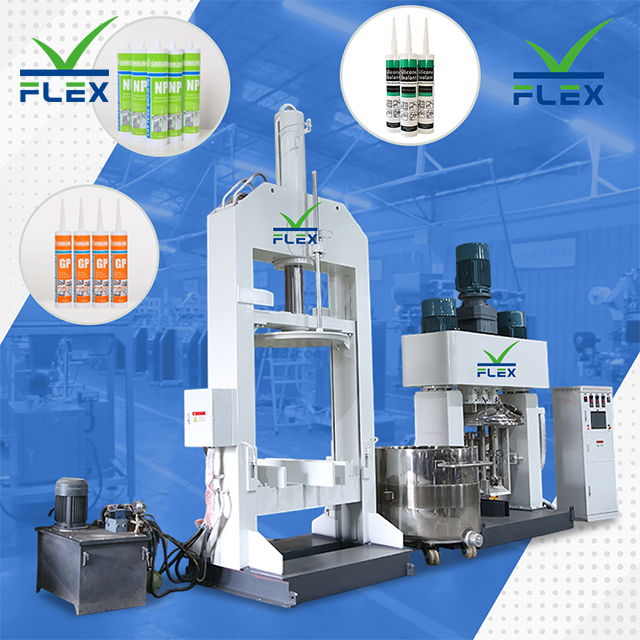
The filling process relies on massive hydraulic press units. Industrial-grade silicone is far too thick to flow via gravity or standard centrifugal pumps. To move the material, a hydraulic ram equipped with a heavy steel follower plate is forced down into the primary mixing vessel. This extreme downward pressure extrudes the compound through heavy-duty, jacketed piping into the waiting drums. Preventing surface curing during this bulk transfer is a critical operational hurdle. Industrial filling systems frequently incorporate platen seals or nitrogen-purged environments to shield the wide surface area of the sealant from atmospheric moisture. Accuracy is strictly maintained via integrated floor scales that automatically trigger shut-off valves the millisecond the precise target weight is achieved.
Procuring a standalone filler addresses only the final stage of manufacturing. To achieve consistent output and safeguard chemical integrity, plant managers must view their equipment as a highly synchronized, interconnected system. A highly efficient silicone sealant production line operates linearly. A bottleneck at any single stage will paralyze the entire factory floor.
The journey begins in the compounding phase using high-torque double planetary mixers. These robust machines blend base polymers, fumed silica fillers, and cross-linking agents at extreme viscosities without stalling the motors. Once the batch achieves uniform consistency, the mixing vessel is rolled under a hydraulic discharge press. This press acts as the vital bridge between compounding and packaging. It utilizes a hydraulic ram to push the dense material out of the tub and directly into the manifold of the filling station. Properly synchronizing the discharge rate of the press with the intake capacity of the filler via Programmable Logic Controller systems is essential to maintain an uninterrupted production flow.
Modern production facilities integrate rigorous quality control mechanisms directly into the material handling workflow. Vacuum degassing represents the most vital of these processes. During the intense planetary mixing phase, ambient air is inevitably folded into the viscous compound. Failing to extract this trapped air will ruin the final packaged product.
Industrial mixers operate under a deep, continuous vacuum to pull air bubbles out of the matrix before the curing agents are even introduced. The piping connecting the hydraulic press to the filling equipment is often temperature-jacketed. Maintaining a consistent material temperature ensures the sealant's viscosity remains perfectly stable. This thermal stability guarantees that the volumetric dosing at the nozzle remains empirically accurate during the first shift of the morning or the final run of the night.
Navigating the equipment procurement process requires matching machine specifications directly to your chemical formulations and sales projections. Use these core engineering criteria to standardize your selection process.
Packaging Format | Typical Volume | Primary Market Target | Equipment Core Technology | Job-Site Waste Profile |
|---|---|---|---|---|
Rigid Cartridge | 300ml | Retail DIY & Small Trade | Bottom-up volumetric fill, hard plunger insertion | High (Retains original shape) |
Foil Sausage | 600ml | Commercial Construction | Dual-cylinder continuous extrusion, wire clipping | Extremely Low (Compresses to flat disk) |
Bulk Pail / Drum | 20L / 200L | Industrial OEM & Aerospace | Hydraulic follower plate, gravimetric scale shut-off | Moderate (Recyclable steel/plastic) |
The defining metric in machine selection is your required output, measured in units per minute. Calculating your target units per minute based on Overall Equipment Effectiveness helps determine the precise level of automation your facility requires. Relying on semi-automatic machinery when your sales forecasts demand 5,000 cartridges per day will result in costly overtime and inconsistent output. Upgrading to an automated line requires a higher initial capital expenditure, but eliminating manual tube feeding drastically reduces hourly labor dependencies.
Silicone formulations do not behave uniformly under pressure. A standard acrylic decorators' caulk flows much easier than a high-modulus structural glazing silicone. It is imperative that the pumps, pneumatic valves, and servomotors of the prospective machine are explicitly rated for the centipoise and tackiness of your specific chemical formulation. Standard pneumatic pumps handle medium-viscosity materials well. Highly viscous structural sealants demand robust servo-driven volumetric pumps or heavy-duty hydraulic extrusion systems to prevent motor burnout and excessive wear on internal seals.
Facilities rarely run a single product type indefinitely in a dynamic manufacturing environment. The ability to pivot between different formulations, such as moving from a clear sanitary silicone to a black automotive polyurethane, is a massive operational advantage. Evaluate the equipment's mechanical changeover time closely. Machines designed with quick-release sanitary clamps, tool-less adjustment rails, and automated Clean-In-Place protocols significantly minimize downtime between production batches.
Procurement teams frequently ask if a single machine can handle both rigid plastic cartridges and soft sausage foil packs. Understanding the stark mechanical limitations of filling equipment is crucial for avoiding catastrophic purchasing errors.
You cannot use the same machine for both formats due to the vastly different physical properties of the packaging materials. A cartridge filler relies on immense vertical pressure to force a rigid plastic plunger into a hard cylinder. A sausage filler must gently manipulate a continuous sleeve of thin foil, dynamically clipping and cutting the soft material without puncturing it. Attempting to retrofit or modify one machine to perform both tasks inevitably results in sub-optimal performance, severe defect rates, and voided warranties.
Successful manufacturers optimize their return on investment through intelligent factory layout and material routing rather than searching for a non-existent universal filler. The most efficient facilities utilize a centralized compounding and pressing station that acts as the heart of the operation to feed multiple dedicated packaging lines.
Installing a high-capacity hydraulic discharge press equipped with a heavy-duty, dual-valve manifold allows operators to direct the flow of the silicone batch either to a dedicated cartridge line or a dedicated sausage line with the turn of a valve. This modular approach allows the business to pivot production instantly based on current retail or commercial orders, ensuring expensive mixing equipment never sits idle.
Matching your specific packaging format to your target demographic is the foundational step toward manufacturing profitability. The machinery you ultimately select will define your factory's overall production efficiency, shape your long-term labor costs, and guarantee the consistency of your product quality during every single shift.
Objectively evaluate your current production bottlenecks, material viscosity, and output requirements to build a highly optimized workflow that scales alongside your business. Do not let outdated packaging methods limit your market reach. For chemical manufacturers ready to optimize their production floor, partnering with specialized machinery experts like Flex Machinery ensures you secure the exact automated solutions needed to dominate both the retail and commercial sealant markets.
A cartridge machine is engineered to fill rigid plastic or cardboard tubes, sealing them by forcefully inserting a hard plastic plunger into the base. A sausage filling machine pumps the sealant into a soft, continuous aluminum foil tube and seals both ends using specialized wire clips. Because the packaging materials and sealing mechanics are entirely different, they require dedicated, separate machines with distinct engineering principles.
Upgrading to a fully automatic line is highly recommended from a financial standpoint if your daily production demand consistently exceeds 25 to 30 cartridges per minute. It completely eliminates the need for manual tube and plunger loading to drastically reduce ongoing labor costs. Automated lines utilize precise servo-driven systems that ensure a much more consistent, air-free fill, thereby reducing product rejection rates and material waste.
Yes, provided the equipment is specified correctly during the initial purchasing phase. High-quality semi-automatic machines are equipped with robust pneumatic or hydraulic extrusion systems designed specifically to push thick, high-viscosity materials like polyurethane and structural silicone sealants. Communicating your material's exact centipoise rating to the manufacturer ensures the pump and motor are appropriately sized.
The necessary footprint varies significantly based on your chosen levels of automation. A basic semi-automatic setup can operate comfortably within a few hundred square feet. A fully automated line encompassing double planetary mixers, hydraulic discharge presses, automatic fillers, and downstream case packers requires a dedicated industrial facility layout, often spanning well over a thousand square feet.
Sausage packs generate up to 95 percent less waste volume than traditional plastic cartridges when disposed of on construction sites. This perfectly aligns with modern environmental regulations and drastically reduces dumpster fees. They are more cost-effective to manufacture per unit, easier to ship in bulk due to their compressible shape, and highly preferred by professional contractors for large-volume, continuous dispensing applications.
Preventing air bubbles requires a two-step approach. First, the raw material undergoes vacuum degassing during the mixing phase to pull out ambient air. Second, the filling machine utilizes a bottom-up extrusion method. The filling nozzle descends to the very bottom of the packaging and slowly retracts as the sealant is pumped in, ensuring no empty air pockets are trapped beneath the dense material.
For facilities currently running multiple shifts with semi-automatic equipment, upgrading to a fully automated line typically yields a full return on investment within 12 to 18 months. This rapid ROI is driven by the complete elimination of manual loading labor, significantly higher units-per-minute output, and a drastic reduction in material waste and rejected batches caused by human error.


