
English
Views: 0 Author: Site Editor Publish Time: 2026-10-31 Origin: Site


In profile wrapping, a faster production line does not always mean higher productivity. If the adhesive loses its ability to bond before the wrapping material reaches the profile, edges may lift or the film may detach. If the adhesive application and pressure conditions are unsuitable, bubbles, wrinkles, and uneven bonding can also occur.
For manufacturers wrapping MDF, solid wood, PVC, or aluminum profiles, the challenge is to match the adhesive's working time with the actual production process.
Choosing the right PUR hot melt adhesive for profile wrapping involves more than comparing curing speed. Manufacturers also need to consider open time, initial tack, substrate compatibility, coating weight, and the distance between adhesive application and the pressure rollers.
Understanding how these factors work together can help reduce wrapping defects and establish a more stable production process.
PUR adhesive open time refers to the period during which an applied adhesive remains suitable for bonding before the wrapping material is brought into contact with it. The exact definition and test conditions may vary by adhesive supplier, so manufacturers should refer to the technical data sheet for the selected grade.
Open time is different from curing time.
PUR hot melt adhesive develops initial holding strength as it cools. Moisture then contributes to the chemical curing process, allowing the adhesive to develop its final bond properties over time. Initial tack helps hold the wrapping material in position, while final bond strength develops through the subsequent curing process.
These stages affect different parts of production:
Open time determines how long the adhesive remains suitable for bonding after application.
Initial tack or green strength affects how well the wrapped material stays in position during early handling.
Final curing determines when the adhesive has developed the required long-term bond performance.
A suitable adhesive needs to provide enough working time for the wrapping process while developing sufficient initial holding strength to keep the film or veneer in place after pressure is applied.
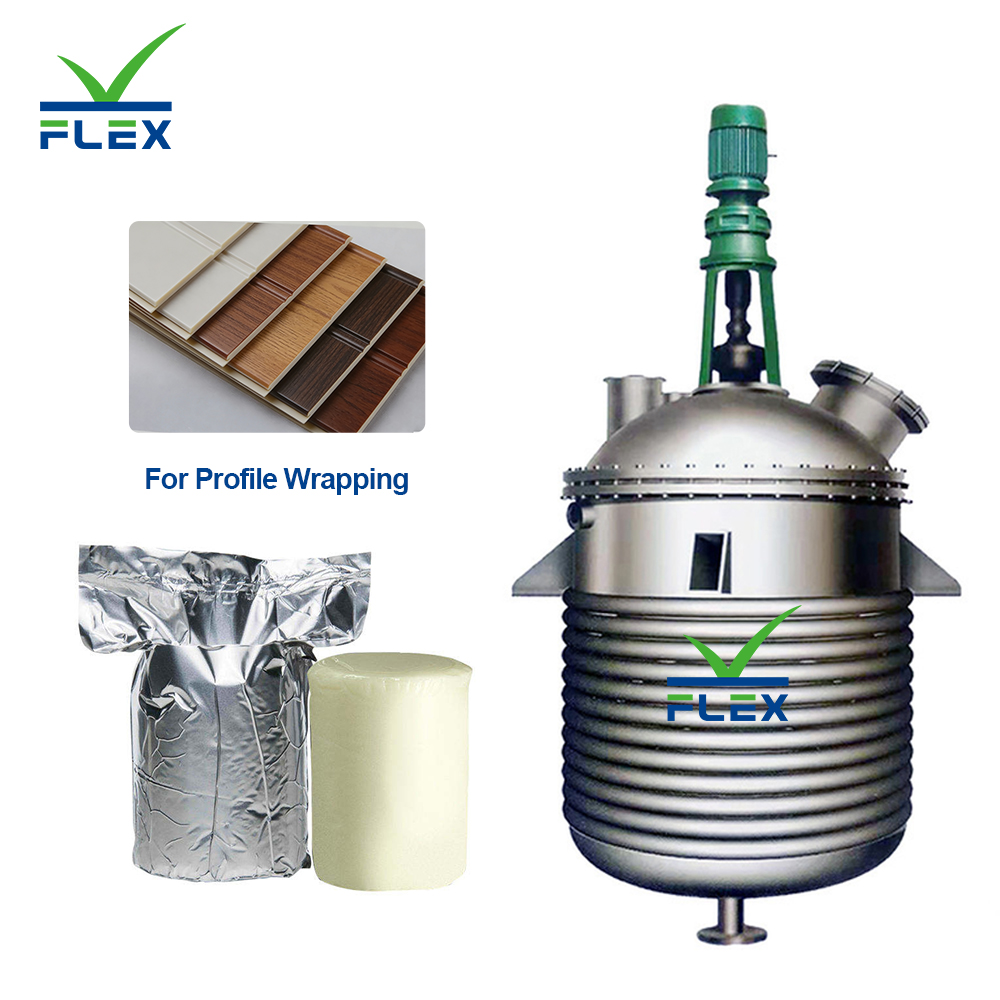
For manufacturers comparing different grades, PUR hot melt adhesive for profile wrapping is a relevant starting point. The product is described as a one-component, moisture-curing polyurethane adhesive designed for profile-wrapping applications, with long open time and high initial tack.
Line speed determines how quickly a profile moves through the adhesive application and wrapping stages. It affects output, but it also changes the time available for material positioning, pressure application, and process adjustment.
The relationship between speed and open time is not simply that faster is always better or slower is always safer.
If the adhesive loses its bonding capability before the film or veneer reaches the required contact point, the materials may not bond properly.
Possible symptoms include:
Film or veneer lifting shortly after wrapping
Poor adhesion around corners and grooves
Inconsistent bonding along the profile
Increased scrap during production
Before increasing line speed, check whether the adhesive is suitable for the substrate and process. Also review adhesive temperature, substrate temperature, coating uniformity, and the actual time between application and contact.
Increasing speed without addressing the underlying cause may simply introduce a different production problem.
A profile may appear adequately wrapped as it exits the machine but develop lifting or movement during handling.
This can indicate that the adhesive has not developed enough initial holding strength for the profile geometry and wrapping tension. Pressure roller alignment, contact pressure, adhesive selection, and substrate compatibility should all be checked.
Complex profiles may require more careful roller adjustment because the wrapping material must follow corners, recesses, and curved surfaces without pulling away.
Higher speed can reduce the time available for accurate positioning and consistent pressure application. It may also expose limitations in adhesive delivery, temperature control, or material handling.
The correct production speed is therefore the speed at which the complete process consistently meets the required quality standards—not simply the maximum speed displayed on the machine.
The most reliable approach is to evaluate the adhesive and equipment together under the actual production conditions.
Start by identifying the distance between the adhesive application point and the point where the wrapping material makes effective contact with the profile.
At a constant line speed, the approximate travel time can be calculated as:
Travel time (seconds) = Distance (meters) ÷ Line speed (meters per minute) × 60
For example, if the distance is 1 meter and the line speed is 12 meters per minute, the travel time is approximately 5 seconds.
This calculation helps establish the time available between application and contact. It does not, by itself, determine the correct adhesive open time. The adhesive's technical data, substrate conditions, pressure arrangement, and process tolerances must also be considered.
Allow for normal production variation rather than setting the process so close to the adhesive's working-time limit that minor interruptions cause bonding problems.
Different profile-wrapping applications place different demands on the adhesive.
Furniture trim and decorative MDF profiles may use different surface materials from PVC window profiles or aluminum architectural components. The film, veneer, substrate, and intended service environment all influence adhesive selection.
FLEX's PUR profile-wrapping adhesive is listed for applications involving PVC, PP, PET, and CPL films, as well as MDF, solid wood, aluminum alloy, veneer, and other facing materials within the specified thickness ranges.
These listed applications provide a starting point for selection, not a guarantee that every combination will work without testing. Confirm compatibility with the supplier when changing substrates, films, or production conditions.
Temperature influences adhesive viscosity and coating behavior. If the adhesive is too cool for the selected application system, it may become difficult to apply uniformly. Excessive heat or unsuitable temperature settings may also affect adhesive stability or damage heat-sensitive wrapping materials.
Check the recommended operating temperatures for the adhesive grade and the equipment. Where the system has separate heating zones, confirm that the melter, hoses, and application components are configured according to the manufacturer's instructions.
Avoid applying a universal temperature setting to every PUR adhesive. The correct values depend on the formulation and the equipment.
The amount of adhesive applied affects bond formation, appearance, material consumption, and processing behavior.
Too little adhesive may result in incomplete coverage or weak bonding. Too much may cause squeeze-out, visible adhesive lines, or an uneven finish.
FLEX's product page lists a minimum application rate of 30 g/m² for its profile-wrapping adhesive under the described conditions. This is a product-specific reference, not a universal setting for every profile or substrate.
The actual coating weight should be confirmed through trials that assess surface coverage, adhesion, appearance, and production stability.
Even a suitable adhesive may produce poor results if the wrapping material is not pressed evenly against the profile.
Inspect the roller arrangement, alignment, contact pressure, and condition of the roller surfaces. Confirm that the wrapping material follows the profile contour without excessive tension or wrinkles.
For profiles with deep grooves or sharp corners, the pressure arrangement may need additional adjustment to ensure adequate contact in these areas.
If flat surfaces bond well but corners lift, investigate pressure distribution, profile geometry, adhesive compatibility, and working time before making broad changes to the production speed.
The adhesive's behavior is influenced by more than the machine settings. Factory temperature, substrate temperature, humidity, and the condition of the materials can all affect the wrapping process.
A cold profile can cool the hot melt adhesive more quickly after application. This may shorten the practical working window and affect how well the wrapping material wets and bonds to the surface.
When seasonal changes or material storage conditions cause noticeable temperature differences, monitor the substrate temperature during production and evaluate whether the process needs adjustment.
Any preheating procedure should be compatible with the substrate and adhesive manufacturer's recommendations.
PUR hot melt adhesive cures through a moisture-related chemical reaction after application. Humidity can therefore influence curing behavior, although its effect on practical open time should not be treated as identical for every formulation.
Monitor environmental conditions when investigating changes in early bond performance or final curing. Follow the supplier's handling and storage instructions to prevent unwanted moisture exposure before application.
Dust, oil, surface treatments, coatings, and differences in material porosity can affect adhesion. Before changing the adhesive or line speed, confirm that the profile and wrapping material meet the required cleanliness and preparation conditions.
For porous substrates such as wood-based materials, moisture content and surface quality may also influence the finished result.
Adhesive selection and machine configuration need to work together. Stable melting, controlled delivery, and consistent application help maintain repeatable coating conditions throughout production.
When evaluating a PUR hot melt adhesive machine, manufacturers should consider the following factors:
Adhesive capacity: Confirm that the system can support the required production volume and adhesive consumption.
Temperature control: Check whether the heating system is suitable for the selected PUR formulation and operating conditions.
Adhesive delivery: Evaluate whether the pump and delivery arrangement provide a stable supply at the required output.
Application compatibility: Confirm that the dispensing system is suitable for the intended coating method and profile geometry.
Moisture protection: Check the equipment's provisions for handling moisture-sensitive PUR adhesive.
Maintenance requirements: Review cleaning procedures, shutdown requirements, and measures to prevent adhesive curing inside the system.
FLEX's SP-PUR55 model is designed for 200 kg PUR hot melt adhesive barrels. Its published specifications include adjustable adhesive output, progressive heating, and temperature-control features. The appropriate configuration and delivery rate should be confirmed against the specific profile-wrapping process before purchase.
For a broader overview of adhesive options, manufacturers can also review the PUR hot melt adhesive product range, which includes grades with different viscosity and open-time characteristics for different applications.
When a wrapping defect appears, avoid changing several process settings simultaneously. A systematic check makes it easier to identify the cause and determine whether the correction works.
Problem | Possible causes | What to check first |
|---|---|---|
Film or veneer peels away | Poor wetting, unsuitable adhesive, contamination, or insufficient contact | Adhesive compatibility, surface condition, temperature, and time to contact |
Corners or grooves lift | Uneven pressure, profile geometry, material tension, or insufficient early holding strength | Roller alignment, pressure distribution, and wrapping tension |
Adhesive squeezes out | Excessive application, unsuitable viscosity, or excessive pressure | Coating weight, adhesive temperature, and roller settings |
Bubbles appear beneath the film | Trapped air, uneven application, substrate moisture, or surface defects | Substrate condition, coating uniformity, and material contact |
Bonding varies between runs | Temperature changes, inconsistent application, material variation, or moisture exposure | Process records, adhesive delivery, and environmental conditions |
These symptoms are not unique to a single cause. The correct troubleshooting procedure should be based on inspection, technical data, and controlled production trials.
Before raising the operating speed, confirm the following:
The adhesive grade is suitable for the profile, wrapping material, and intended service environment.
The open time is appropriate for the actual application-to-contact interval.
Adhesive temperature and delivery remain stable at the proposed operating speed.
Coating weight is sufficient for consistent coverage without unnecessary squeeze-out.
Pressure rollers are aligned and provide suitable contact across the profile.
The wrapping material can follow corners and grooves without excessive tension.
Trial runs meet the required standards for adhesion, appearance, and repeatability.
Record the adhesive grade, temperature settings, coating weight, line speed, and material combination for each successful trial. These records provide a useful starting point when the production line is adjusted or a new profile is introduced.
There is no single ideal open time for every profile-wrapping process. The required window depends on the adhesive formulation, substrate combination, line layout, application-to-contact interval, and production conditions. Consult the adhesive's technical data sheet and verify the process through trials.
No. A shorter open time may suit a process that brings the wrapping material into contact quickly, but it can leave insufficient working time if positioning or pressure application takes longer. The adhesive and machine must be evaluated together.
Possible causes include unsuitable adhesive selection, poor surface preparation, inadequate contact pressure, inconsistent coating, or an open-time mismatch. Check the failure pattern and process conditions before changing the line speed.
Some grades are designed for multiple substrates, but compatibility depends on the specific materials, surface treatments, and service conditions. Confirm the supplier's specifications and test the intended combinations before full-scale production.
Maintain consistent adhesive delivery, apply an appropriate coating weight, prevent unnecessary squeeze-out, and establish repeatable operating settings. Regularly reviewing defects and material consumption can help identify opportunities to improve efficiency without compromising bond quality.
Reliable profile wrapping depends on the interaction between adhesive open time, line speed, temperature, coating weight, substrate compatibility, and pressure application.
The goal is not simply to select the fastest-setting adhesive or run the machine at maximum speed. It is to establish a stable operating window that delivers consistent bonding, clean edges, and the required finished appearance.
For manufacturers evaluating a new adhesive grade or improving an existing production line, FLEX Machinery offers PUR hot melt adhesive for profile wrapping, together with PUR hot melt adhesive equipment for industrial adhesive handling.
Confirm your substrate materials, target production speed, and application requirements with the supplier to identify a suitable adhesive and equipment configuration for your process.


