
English


| Quantity: | |
|---|---|


This polyurethane reactive (PUR) hot melt adhesive delivers an immediate, aggressive initial grab upon application. As the adhesive is extruded onto the substrate, it exhibits exceptional wetting characteristics, spreading evenly across porous and non-porous surfaces alike, including solid wood, MDF, particleboard, wood veneer, and PVC films. This rapid physical bonding phase ensures tight fitting within mere seconds, virtually eliminating hollow spots and allowing automated flat lamination lines to operate at peak speeds without the risk of substrate shifting.
Advanced Curing Mechanism & Structural Stability
Utilizing a sophisticated dual-curing technology, this adhesive first secures materials through physical cooling and solidification. Following this, it undergoes a chemical cross-linking process triggered by ambient moisture. This reaction forms an irreversible, deeply integrated polymer network. The resulting bond offers up to twice the structural pull-off strength of standard alternatives, ensuring that decorative films and core panels remain firmly fused. Even under continuous mechanical stress, the bonded layers resist delamination, warping, or peeling.
Exceptional Waterproofing & Thermal Resilience
Once the moisture-curing process is complete, the adhesive line transforms into a highly dense, impenetrable barrier. This cured layer completely repels water penetration, making it exceptionally reliable for environments with fluctuating humidity, such as bathrooms or coastal properties. Furthermore, the cross-linked structure withstands extreme temperature variations. It will not soften, reflow, or become brittle, maintaining absolute structural integrity whether exposed to intense summer heat or freezing winter conditions.
Engineered specifically for flat lamination equipment, the adhesive maintains a consistent, controlled viscosity that prevents bubbling or uneven ridges during application. When the decorative film is pressed onto the panel, the adhesive spreads into a perfectly uniform layer. The final laminated surface feels entirely smooth to the touch, presenting a visually flawless finish that elevates the perceived value and aesthetic appeal of cabinet doors, wall panels, and interior fixtures.
Formulated with a 100% solvent-free composition, this adhesive boasts ultra-low volatile organic compound (VOC) emissions. It strictly complies with international environmental and safety standards, including RoHS and REACH. During the melting and application phases, operators experience a cleaner working environment free from harsh chemical odors. This commitment to safety ensures the final laminated furniture meets the most rigorous indoor air quality requirements for global export markets.
| Product Parameter | ||
| 1 | Product name | PUR Hot Melt Adhesive-for wood lamination |
| 2 | Application | For Wood Lamination |
| 3 | Ingredient | MDI, polyester resin, polyether polyol |
| 4 | Appearance | white solid block |
| 5 | Properties | Low & high temperature resistance, oil & ink erosion resistance, excellent adhesion, good flexibility and thermostability. |
| 6 | Viscosity | approx.2000-4000mPa.s@120°C |
| 7 | Applicable machine temperature | 110°C-130°C, adjustable according to substrates, ambient temperature and machine speed |
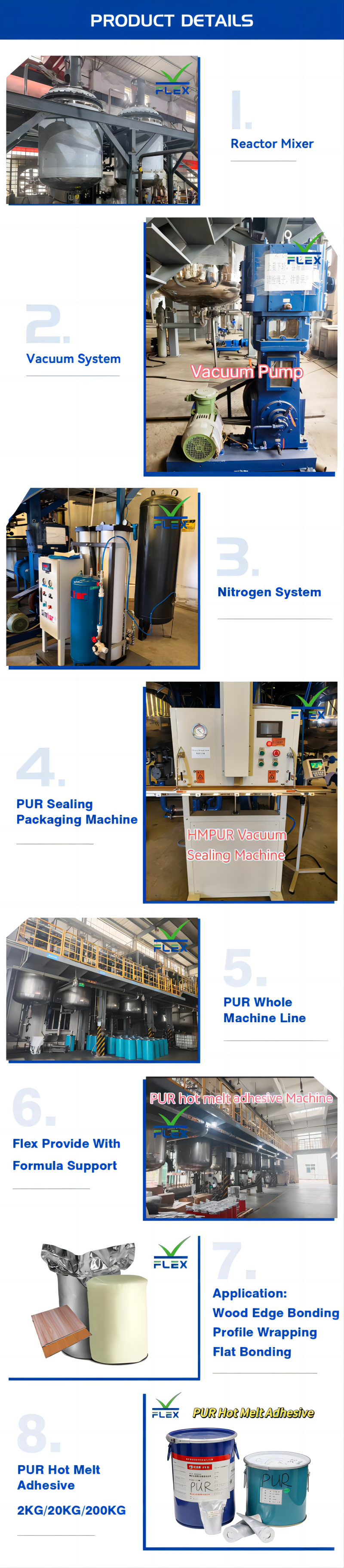
| 8 | Packing | 2KG-20KG-200KG |
| 9 | Application | 1. Flat lamination for solid wood, MDF, particleboard and other wood-based panels. 2. Flat lamination for custom furniture such as cabinets, wardrobes and decorative panels. |
The parameters detailed above highlight the precise formulation of our PUR hot melt adhesive. The specific viscosity range of approximately 2000-4000 mPa.s at 120°C guarantees smooth, continuous pumping through automated application nozzles without clogging or stringing. Operating strictly within the 110°C-130°C temperature window ensures the adhesive melts into a homogenous fluid while preventing thermal degradation of delicate decorative films. These exact specifications provide operators with a reliable baseline for calibrating machinery, ensuring consistent output across varying ambient temperatures and production speeds.
This adhesive serves as the critical bonding agent for constructing premium interior furniture. It successfully marries core materials like solid wood, MDF, and particleboard with decorative surfaces including natural veneer, PVC, and acrylic films.
Creates a perfectly flat, ridge-free surface for cabinet doors and wardrobes.
Enhances the durability of tabletops against daily wear and mechanical stress.
Prevents edge lifting on heavily used furniture components over years of service.
In architectural and interior design applications, long-term stability is paramount. This adhesive is extensively used in manufacturing decorative wall systems and ceiling panels installed in demanding environments.
Maintains bond integrity in moisture-rich areas like commercial kitchens and bathrooms.
Resists warping caused by central heating systems or direct sunlight exposure.
Supports heavy decorative laminates without sagging or separating over time.
Designed to keep pace with modern manufacturing demands, the adhesive accommodates rapid processing speeds on automated flat lamination machinery.
Extended open time allows for precise alignment of large format panels.
Fast initial grab prevents material shifting as panels move through compression rollers.
Consistent flow rate minimizes line stoppages, reducing material waste and boosting output.
Beyond standard furniture, the adhesive's robust properties meet the strict performance criteria required for specialized construction and industrial wood-based products.
Bonds acoustic panels requiring specific vibration dampening properties.
Secures flooring underlays subjected to continuous, heavy foot traffic.
Assembles exterior door skins that demand superior weather and moisture resistance.
Begin by setting the melter tank temperature strictly between 110°C and 130°C. Allow sufficient time for the solid adhesive block to transition into a completely uniform, smooth liquid. It is crucial to monitor the temperature gauges; exceeding the recommended heat range will cause the adhesive to degrade, darkening in color and losing its chemical bonding efficacy, while under-heating will result in poor flow and blocked nozzles.
Calibrate your application machinery according to the specific substrate thickness and the flexibility of the decorative film. Adjust the slot nozzle or roller applicator to dispense an even, consistent layer of adhesive. Fine-tune the feeding speed and the pressure of the nip rollers to ensure the adhesive spreads uniformly, preventing both starved joints (hollow spots) and excessive squeeze-out at the panel edges.
Initiate the automated line by feeding the core panel and decorative film simultaneously. As the adhesive is applied, the materials must immediately pass through the pressing station. Apply uniform, continuous pressure across the entire surface area to force the adhesive into the microscopic pores of the wood. Maintain a steady line speed to allow the physical cooling phase to lock the materials together before they exit the machine.
Because PUR adhesive reacts with moisture in the air, strict sealing protocols are mandatory. Immediately after production halts, hermetically seal the glue tank and the feeding hoses. Purge and clean the application nozzles to prevent cured adhesive from blocking the system. Store all unopened adhesive blocks in a cool, dry facility, utilizing moisture-proof packaging to maximize the 6–12 month shelf life and protect operators from handling compromised materials.
To guarantee your production line operates without interruption, we provide extensive technical support. Our specialists assist with initial equipment parameter tuning, on-site trial production runs, and establishing routine maintenance schedules for glue tank cleaning, ensuring your automated systems deliver consistent, reliable output day after day.
The recommended melting temperature is strictly 110–130°C. Maintaining this exact thermal window ensures the adhesive achieves optimal fluidity for smooth application while preserving its chemical cross-linking properties. Overheating destroys the polymer structure, leading to brittle bonds and a drastically shortened service life, whereas under-heating results in poor substrate penetration.
It must be stored in a climate-controlled, dry environment away from direct sunlight. Unopened foil packaging provides a shelf life of 6–12 months. Because PUR relies on airborne moisture to cure, maintaining absolute airtight seals on both stored inventory and idle machinery tanks is critical to prevent the adhesive from solidifying prematurely.
This formulation is highly versatile, creating exceptional bonds between porous core panels (solid wood, MDF, particleboard, plywood) and various decorative overlays (natural wood veneer, PVC, PET, and acrylic films). It is specifically engineered to handle the differing expansion rates of these materials in premium furniture manufacturing.
4. How can operators eliminate bubbles and ensure a perfectly flat fit?
Achieving a flawless finish requires a multi-step approach: first, ensure all substrates are completely free of dust and surface moisture. Second, calibrate the applicator to dispense a strictly uniform coating thickness. Finally, synchronize the feeding speed with consistent, even pressure from the lamination rollers to expel trapped air and eliminate hollow spots.
When compared to standard EVA or solvent-based glues, PUR demonstrates overwhelming superiority in long-term structural integrity. While EVA simply cools to bond and can remelt under heat, PUR undergoes a chemical cross-linking process that creates an irreversible, waterproof, and temperature-resistant polymer network. This translates to significantly higher pull-off strength and zero risk of delamination in extreme climates, all while remaining 100% solvent-free.
Yes. As a source manufacturer, we provide direct supply and extensive customization. We can adjust the adhesive's open time, viscosity, and initial tack to perfectly match your specific application equipment, substrate types, and line speeds. We also offer complimentary sample testing and dedicated engineering support to validate the formula on your actual production line before full-scale implementation.
 |  |  |  |
 |  |  |  |


