
English


| Quantity: | |
|---|---|


Excellent Initial Tack & Fast Curing
When the edge band meets the substrate, this PUR adhesive immediately grabs the surface. The rapid cross-linking process ensures that panels moving at 20 to 30 meters per minute through automated edge banders experience zero shifting. Operators notice a distinct reduction in holding time, allowing continuous feeding without bottlenecks and significantly elevating daily output volumes.
Ultra-High Bonding Strength & Stability
Unlike traditional adhesives that merely sit on the surface, this reactive polyurethane chemically fuses with wood fibers and polymer edge bands. Once fully cured, trying to peel the edge band will typically result in substrate failure rather than glue line failure. It provides a rigid, structural hold that withstands heavy impacts during transit and daily use, permanently preventing edge lifting or cracking.
The cured glue line forms an impermeable, dense polymer matrix. Moisture from spills, steam, or ambient humidity simply cannot penetrate the joint. This makes it exceptionally reliable for bathroom vanities and kitchen cabinetry, eliminating the dreaded edge swelling and delamination caused by water ingress, thereby extending the functional lifespan of the furniture.
Outstanding Heat & Cold Resistance
Whether exposed to scorching summer temperatures near ovens or freezing winter climates during shipping, the adhesive film remains entirely stable. It resists softening up to 120°C and maintains flexibility well below freezing, ensuring the edge band never shrinks, cracks, or pops off regardless of the geographical destination or seasonal extremes.
Apply less volume while achieving superior coverage. The adhesive spreads into a microscopically thin, translucent film, leaving a nearly invisible joint between the board and the edge band. This precise application eliminates messy squeeze-out and dark lines, delivering the flawless, premium aesthetic demanded by high-gloss and custom decorative panels.
Formulated with strict environmental compliance in mind, this low-VOC adhesive emits virtually no harsh odors during the melting phase. It ensures a safer, more comfortable breathing environment for machine operators while meeting rigorous international indoor air quality standards for the final furniture pieces, protecting end-users from harmful off-gassing.
Every batch undergoes rigorous testing to meet ISO and SGS certification standards. From raw material inspection to final viscosity checks, we guarantee consistent melting behavior and adhesion strength. We provide comprehensive testing reports, giving large-scale manufacturing facilities absolute peace of mind regarding batch-to-batch reliability.
Understanding the precise technical specifications of our reactive polyurethane adhesive is crucial for optimizing your manufacturing parameters. The data below outlines the core physical properties, optimal running temperatures, and viscosity profiles designed to match various automated equipment settings. Strict adherence to these parameters ensures maximum yield and flawless edge sealing.
| Product Parameter | ||
| 1 | Product name | PUR hot melt glue |
| 2 | Application | For wood edge sealing |
| 3 | Ingredient | MDI, polyester resin, polyether polyol |
| 4 | Appearance | white solid block |
| 5 | Properties | Low & high temperature resistance, oil & ink erosion resistance, excellent adhesion, good flexibility and thermostability. |
| 6 | Viscosity | approx.2000-4000mPa.s@120°C |
| 7 | Applicable machine temperature | 110°C-130°C, adjustable according to substrates, ambient temperature and machine speed |
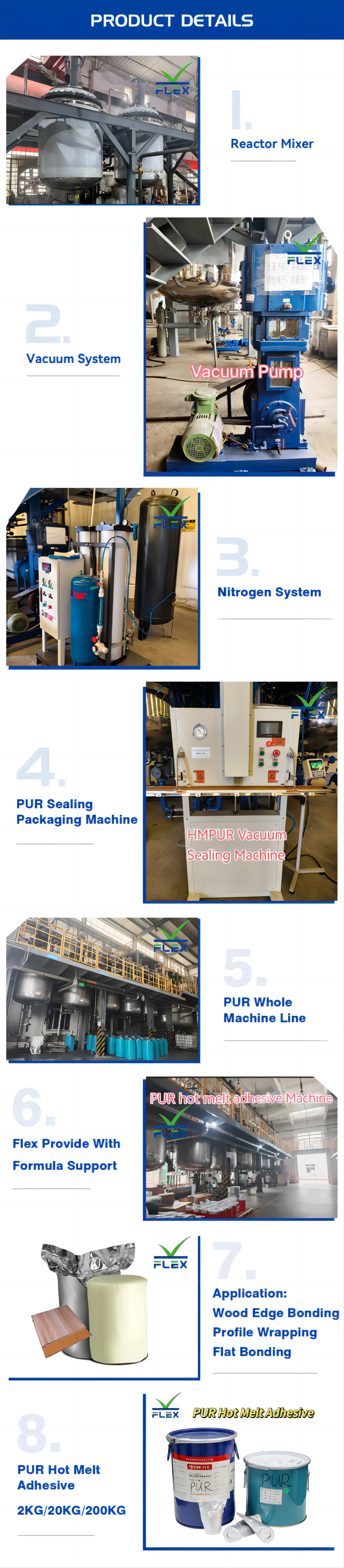
| 8 | Packing | 2KG-20KG-200KG |
| 9 | Application | Edge sealing for solid wood, MDF, particleboard and other wood-based panels. Edge sealing for custom furniture such as cabinets and wardrobes. |
Solid wood naturally breathes, expanding and contracting with seasonal humidity changes. This adhesive cures into a flexible yet incredibly tough polymer network that accommodates wood movement, permanently preventing splitting or delamination along complex profiles and straight edges alike.
Custom Cabinet & Wardrobe Production
Kitchen and bathroom environments subject furniture to constant steam, water splashes, and temperature swings. By creating an impenetrable moisture barrier, this adhesive guarantees that custom vanities and kitchen doors maintain their structural integrity and flawless finish through decades of rigorous daily use.
Engineered specifically for modern manufacturing facilities, the adhesive melts smoothly and flows consistently through application rollers or nozzles. It easily keeps pace with automated edge banding machines running at elevated speeds, eliminating stringing and ensuring continuous, uninterrupted output.
Premium interior designs require absolute visual perfection. When bonding PVC, ABS, or acrylic edge bands to high-gloss panels, the adhesive lays down in a microscopic, transparent layer. This prevents any surface telegraphing or unsightly dark lines, resulting in a monolithic, high-end appearance.
Commercial desks and partition panels endure heavy daily abrasion and impacts. The exceptional shear strength of this adhesive ensures that edges remain firmly attached even in high-traffic corporate environments, significantly extending the lifespan of the furniture and minimizing replacement costs.
1. Initiate the melting process by preheating the glue tank to the strict range of 110–130°C. Allow sufficient time for the solid block to transform into a smooth, even liquid. Operators should monitor the thermostat closely; exceeding this temperature range can degrade the reactive polymers and compromise final adhesion strength.
2. Calibrate the application system based on the specific substrate. Adjust the doctor blade to ensure a thin, consistent coating thickness. Fine-tune the feeding speed and pressure rollers so the edge band is pressed firmly into the wet adhesive before the initial curing phase begins, ensuring maximum contact area.
3. Engage the automated sequence. As the panel moves from feeding to gluing, pressing, trimming, and end-cutting, maintain a constant conveyor velocity. Consistent speed prevents premature cooling of the adhesive line, allowing the chemical cross-linking to initiate perfectly under the pressure station.
4. Post-production care is critical for reactive adhesives. Immediately seal the melting tank and feeding lines to block ambient humidity, which triggers premature curing. Regular purging and cleaning of the application rollers and nozzles are required to prevent cured residue from disrupting future production runs.
5. To support continuous operations, we provide specialized PUR cleaning agents and comprehensive maintenance protocols. Utilizing these dedicated solutions effectively dissolves uncured residue, preventing blockages in the glue pot and application rollers, thereby drastically reducing machine downtime and extending equipment lifespan.
The optimal melting range is strictly between 110°C and 130°C. Maintaining this precise thermal window ensures the adhesive achieves the perfect viscosity for smooth application while preserving its reactive chemical properties. Excessive heat will rapidly degrade the polyurethane structure, leading to poor adhesion and carbonization in the tank.
Due to its moisture-reactive nature, the adhesive is supplied in industrial-grade, highly sealed moisture-proof packaging, such as heavy-duty aluminum foil bags or specialized airtight drums. Store these unopened containers in a cool, dry environment away from direct sunlight. Unopened, the shelf life extends from 6 to 12 months. Once opened, it must be processed quickly or resealed perfectly to prevent ambient humidity from triggering the curing process.
It is exceptionally versatile, engineered to bond a wide array of edge banding materials including PVC, ABS, acrylic, melamine, and natural wood veneers. On the substrate side, it forms unbreakable chemical bonds with particleboard, MDF, plywood, and solid wood, making it the universal choice for diverse manufacturing requirements.
Achieving a flawless edge requires a holistic approach. Ensure the application rollers lay down a uniform, thin film of adhesive. Calibrate the pressure wheels to apply adequate force without crushing the board. Keep all substrates entirely dust-free and dry before application. Proper synchronization of these mechanical factors prevents edge lifting, visible glue lines, and messy squeeze-out.
While EVA relies solely on a physical phase change (cooling), PUR undergoes a secondary chemical cross-linking reaction with moisture in the air and the wood. This creates an irreversible, thermosetting bond. Consequently, PUR offers exponentially higher tensile strength, superior heat resistance (won't remelt), and complete waterproofing, whereas EVA can fail under high heat or moisture exposure.
As a direct source manufacturing facility, we possess robust, large-scale production capabilities supported by a streamlined global supply chain. We are fully equipped to handle substantial volume requirements with rapid response times, ensuring that your production lines never experience downtime due to adhesive shortages.
Yes, we provide comprehensive OEM and ODM solutions tailored to your specific operational needs. This includes flexible packaging configurations ranging from 2KG blocks to 200KG drums, custom color matching to blend perfectly with your materials, and specific viscosity adjustments to suit unique machinery profiles.
 |  |  |  |
 |  |  |  |


